Where riffs go to die
You wrote the best riff of your life on a Tuesday in March. You know this because you remember playing it: drop B, somewhere around 150, one of those parts that makes you look up from the fretboard. You recorded it, too. You are a responsible musician.
So where is it?
Maybe it's a voice memo. There are 214 of those on your phone, and twelve are
called "New one." Maybe it's in a DAW project called
newsong_C_drop_idea3, which is one of forty project folders you would
have to open, one by one, waiting on plugins you are not going to use, forty
times. Maybe it's a bounce on the desktop, or in the band group chat, eleven
months up-scroll, past two arguments about rehearsal times and a hundred memes.
You'll find it eventually. Or you'll rewrite it from memory, slightly worse, and have a nagging feeling about it forever.
The tools are borrowed, and it shows
None of this is a discipline problem. It's a tooling problem, and it's worth being precise about why, because every tool a riff touches was built for something else.
Voice memos are a capture tool. One tap, always in your pocket, genuinely great at the moment of capture. But the app is an inbox nobody empties, and it indexes by the one thing you'll never remember: the timestamp. It cannot know the tuning. You cannot hear the tuning either, not through a phone speaker, which means the memo that mattered is indistinguishable from nineteen that didn't.
A DAW project is a workbench. It's where a riff becomes a song, and it's terrible at being anything else. Opening a project to check whether a riff is any good costs a full load of plugins you're not going to use. So you don't check. Projects accumulate like sealed boxes in a garage: something good is in one of them, and the cost of looking guarantees you never look.
The file system indexes by name, and a filename cannot hold what you actually
remember about a riff. You remember it was drop B. You remember it was fast. You
remember it felt like a chorus. bounce_final_03.wav records none of
that, and the version of you who named it was certain, wrongly, that he'd
remember.
And the group chat is a timeline. Everything in a timeline is on its way out. The riff your guitarist sent in November isn't stored there; it's sinking there, at a fixed rate, under logistics and memes.
Four tools, four different jobs, and not one of them is "keep this findable." That job was never assigned. Every guitarist who records ends up keeping his best work in four apps that don't talk to each other, and then blames himself when he can't find any of it.
What the missing tool would have to be
Once you frame it that way, the requirements write themselves.
It would have to index by what you actually remember: tuning first, because a drop B riff might as well not exist while your guitar is in D standard; tempo, because a 150 BPM idea is useless to the slow song; the feel, in your own words. It would have to search everything, including the note you scribbled about which part goes where. It would have to live on the desktop, next to the DAW, because that's where riffs come from and where they're going. Capture would have to cost nothing: no project file, no ceremony, or you'll skip it on the nights you write best. The band's ideas would have to land somewhere that doesn't scroll. And the files would have to stay yours, on your own disk, in formats any tool can open, because a riff archive you can lose to a subscription lapse is worse than the mess it replaced.
One thing is missing from that list on purpose: the phone. There is no mobile app. Capture on the couch is still a voice memo; the difference is that a memo now has somewhere to go.
None of that is exotic. It's a library. Musicians have needed one for exactly as long as recording has been easy, which is why the mess is universal and nobody thinks of it as a solvable problem. It just feels like weather.
What we built
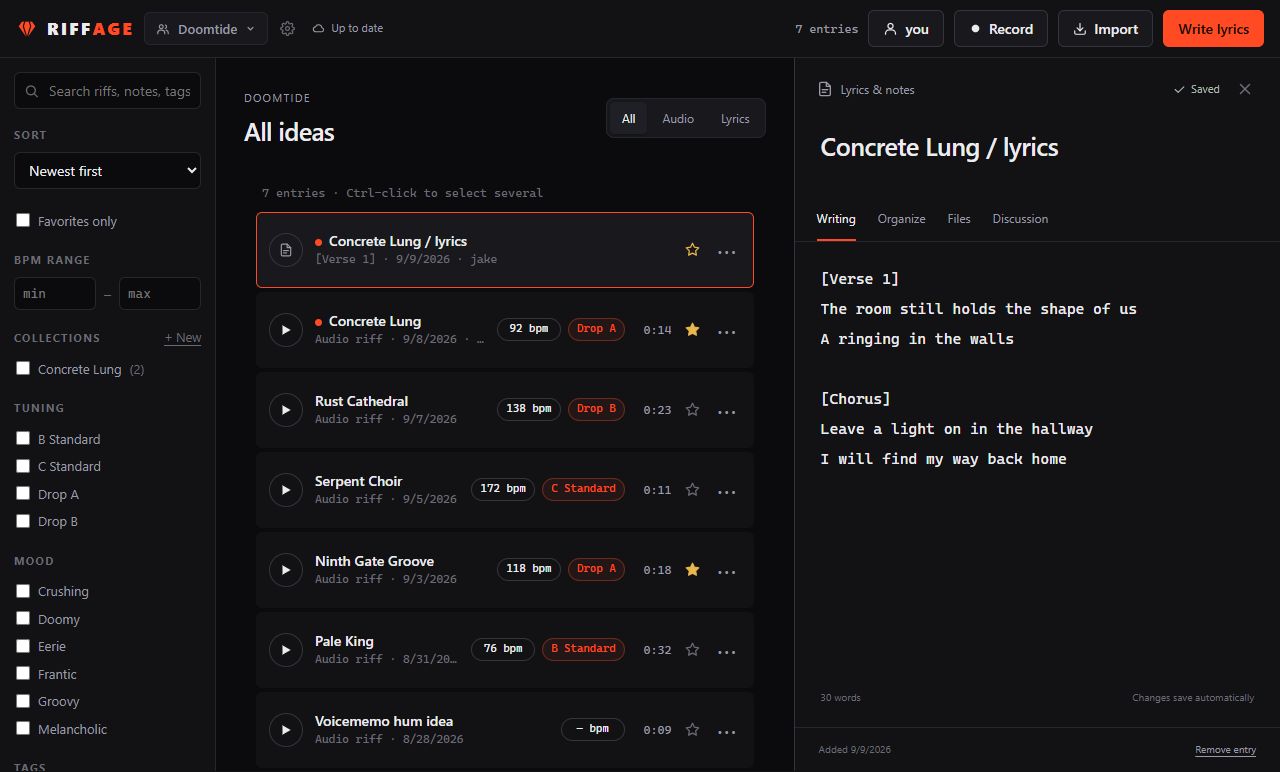
Riffage is that library. I built it because I needed it: my own riffs were the mess above, and my band writes remotely, so every idea crosses a group chat on its way to becoming a song, and you already know what chats do to ideas. It's a desktop app, Windows and Mac, and the honest description is short: every idea you've recorded, in one place, indexed the way you remember it.
Drop your files in, the whole backlog at once if you want, and it measures each one's tempo while you keep playing. Tuning is a field you set once and filter by forever. Mood, tags, stars, notes: all searchable, so "that fast drop B thing that felt like a chorus" is a query with an answer instead of an evening of scrubbing. When a riff earns a song, you drag it from the library straight onto a DAW track.
It records, too, because capture was half the problem. Hit record, play through the amp sims you already own, and the take lands in the library already filed, with the clean DI kept alongside the amped signal so you can reamp it in five years when your taste has changed. No project file was created. Nothing needs a name.
Bands get shared vaults: one searchable library instead of a chat that scrolls, with invitations, comments, and collections for the album that's slowly assembling itself. One person pays; bandmates get in free.
And the part that matters most, given everything above: it's free, and your files are files. Unlimited riffs, on your own machine, forever, in folders you can open without us. The paid part is cloud backup and band sharing, and if you never pay a cent, you still have the library.
Go dig up that riff
The one from that Tuesday in March is still on your hard drive somewhere. This time it'll stay found.